Electronic components in wearable smart watches
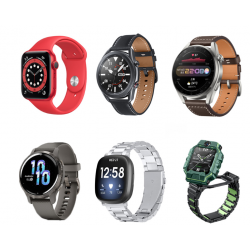
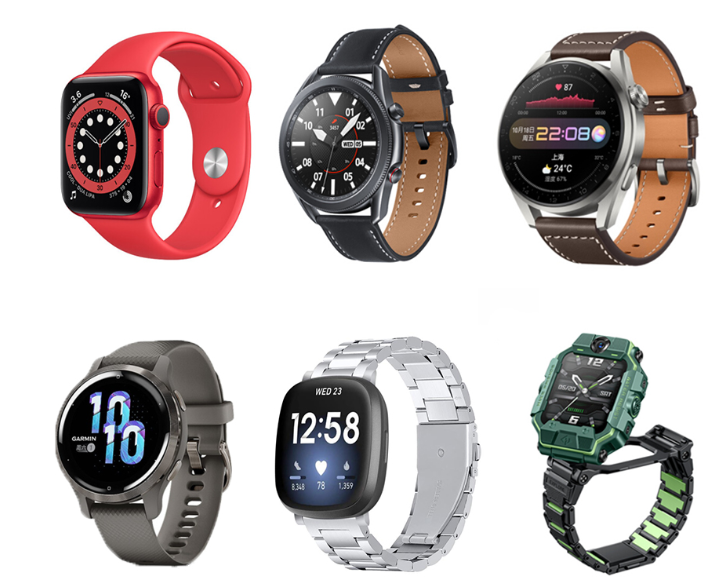
Smart watch solution overview:
Smartwatches usually contain a variety of electronic components that vary in type and function, but some of them are more common. A smart watch is a wrist-worn device that establishes a two-way connection with a smartphone through Bluetooth or Wi-Fi. It is a watch with information processing capabilities and meets the basic technical requirements of a watch. In addition to indicating time, smart watches should also have multiple functions such as reminders, GPS navigation, monitoring, and interaction; the display methods include pointers, numbers, images, etc. It includes vital sign sensors, air pressure sensors, motion sensors, environmental sensors and biological sign sensors. After the information is collected, it is processed by the MCU microcontroller and implemented to make people's lives more convenient.
1. Smart watch core components:
The main electronic component models used in smart watches and their functions are introduced as follows:
Processor (CPU/GPU):
Model: Qualcomm Snapdragon Wear series (such as Snapdragon Wear 4100+)
Function: The Snapdragon Wear processor provides powerful computing power and graphics processing capabilities, allowing the smartwatch to smoothly run applications, process graphics and data.
Memory (RAM/ROM):
Model: LPDDR4 RAM, eMMC or UFS flash memory
Features: LPDDR4 RAM provides fast memory access speed to support multitasking and application running. eMMC or UFS flash memory is used to store operating systems, applications and data, providing larger storage capacity and faster read and write speeds.
sensor:
model:
Accelerometer: STMicroelectronics LSM6DS3
Gyroscope: STMicroelectronics LSM6DS3
Light sensor: AMS TCS34725
Heart rate sensor: AMS AS7000
GPS: u-blox NEO-M8
Barometer/Altimeter: Bosch Sensortec BMP280
Function: These sensors are used to monitor the watch’s movement, environmental conditions, and user physiological data to provide various functions such as health tracking, exercise tracking, navigation, etc.
Display:
Bluetooth: Nordic Semiconductor nRF52 Series
Wi-Fi: Broadcom/Realtek/Other Wi-Fi chips
NFC: NXP Semiconductor PN5180
LTE/4G/5G: Qualcomm Snapdragon X-series modems (such as Snapdragon X12, X20, X55, etc.)
Function: These communication modules enable the smart watch to connect to the Internet, other devices and wireless networks to achieve push notifications, data synchronization, mobile payment, remote communication and other functions.
IDT
Wireless charger P9022
Model: Samsung/BOE/Sharp/Other OLED or LCD screen
Function: OLED or LCD screen provides high resolution, good color performance and low power consumption display effect to display time, notifications, application interface and other content.
Battery:
Model: Lithium-ion battery or lithium-polymer battery (usually no dedicated model)
Function: Provide power supply to support normal operation and long-term use of smart watches.
Communication module:
Model: Maxim Integrated MAX66220
Function: Provides a vibration reminder function so that users can receive notifications, alarm reminders, etc.
Charging module:
Model: Usually custom designed charging circuit and battery management chip
Function: Supports charging of smart watches, usually using magnetic charging or wireless charging.
These are the main electronic component models commonly found in smart watches and an introduction to their functions.
Broadcom provides WiFi chips
Apple Watch is also equipped with a familiar communication chip - BCM4334, which is used in many Apple products, including Apple TV and iPhone 5. BCM4334 is a dual-band single chip that integrates 802.11a/b/g/n and Bluetooth 4.0. It uses it and Skyworks' wireless network switch and low-noise amplifier to realize WiFi and Bluetooth transmission in Apple Watch.
2. Components of a smart watch
Smartwatches are made up of many tiny parts, the most obvious of which are the watch body and strap. There are many types of materials that can be used to make watch straps. The body of the watch is composed of multiple electronic components such as sensors, semiconductors, batteries, touch screens, and displays. Compared with traditional electronic watches, smartwatches rely heavily on the array of electronic components built into the device. Smartwatches may be compact, but they pack a lot of useful features into one device. RF boards, Bluetooth boards, Wi-Fi boards, power management boards, and other sensors or chips are examples of modules.
This article mainly lists the 7 most commonly used sensor types in smart watches currently on the market, which are:
APPLE Watch smart watch disassembly diagram
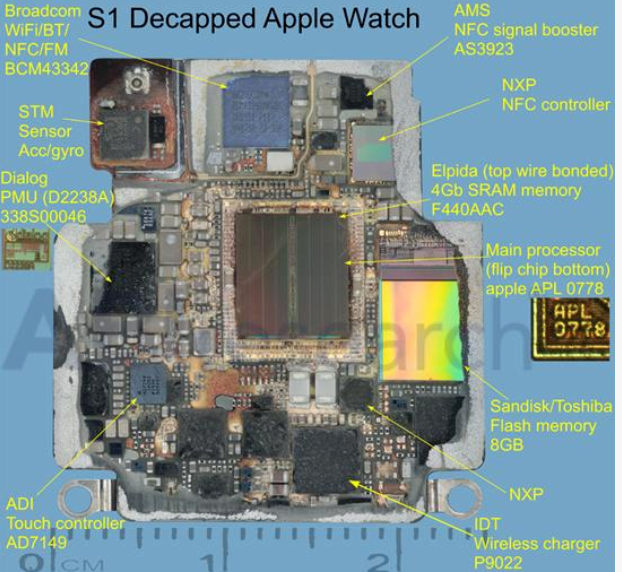
Broadcom wifi/BT/NFC/FM BCM43342
AMS NFC signal booster AS3923
STM Sensor Acc/gyro
Dialog PMU (D2238A)
ADI Touch controller AD7149
AMS NFC Signal booster AS3923
NXP NFC controller
Elpida 4Gb SRAM memory F440AAC
Main processor apple APL 0778
Sandisk/Toshiba Flash memory 8GB
IDT Wireless charger P9022
ü Accelerometer
ü Heart rate monitoring
uGPS
ü Gyroscope
ü Screen
ü Processor
1. Accelerometer
Generally speaking, accelerometers measure acceleration, or the rate at which an object's speed changes, to determine whether the user is moving. Therefore, it is the sensor of choice for all smartwatches. For example, all Starmax watch ranges are equipped with accelerometers to measure the user's movement, such as the S5, S90 (children's watch) and GTS2.2. Heart rate monitor
A heart rate monitor (HRM), sometimes called a heart rate sensor, is a device used to monitor and record a person's heart rate and pulse. Today, most smartwatches include this type of sensor for heart rate detection functionality. Starmax includes a heart rate sensor in the GTS4 that detects blood flow via photoplethysmography (PPG) to provide an accurate reading of the wearer's pulse and heart rate. The heart is an important organ that oversees blood flow in the human body. Healthy circulation will deliver the right amount of blood to all organ sites at an acceptable rate. Therefore, changes in blood volume are closely related to pulse rate. Most smartwatches feature heart rate sensors that work on this concept to assess the wearer's pulse and heart rate by monitoring blood flow at the wrist. PPG (photoplethysmography) is the most widely used heart rate detection method. It is a non-invasive monitoring method that uses optical means to monitor hemoglobin volume changes. All Starmax smartwatch models, including the S90 (Starmax children's wearable), GTS1, GTS2 and S50, come equipped with a PPG heart rate sensor. From a spectroscopic perspective, red and green are opposite colors, so in principle, red plasma will absorb green light. The PPG heart rate monitor is an important sensor due to its ability to detect heart rate and pulse by monitoring changes in the intensity of reflected green light.
3. Gyroscope
Gyroscopes and accelerometers are two types of sensors used to measure the acceleration of an object, but they work in a similar way. Gyroscopes are mainly used to record the angle of an object to record its rotation speed and direction changes. To locate objects more precisely, some smartwatch manufacturers use a combination of accelerometers and gyroscopes for triangulation. Gyroscopes and accelerometers are two devices used to measure the speed of an object, but they work on different principles. Gyroscopes are primarily used to track the angle of an object to capture its angular velocity and direction changes. To locate objects more precisely, some smartwatch manufacturers use a combination of accelerometers and gyroscopes for triangulation.
4. Global Positioning System
Global Positioning System (GPS) is another popular feature in high-end smartwatches, which uses signals from satellites to identify the device's precise location and track its movement over time. Therefore, it makes step counting more accurate. Additionally, it can provide a more complete picture of your daily activity levels (for example, by outlining the best routes for running and cycling). But the price is higher because GPS smart watches have strict signal reception requirements. For GPS smartwatches, real-time positioning also means shorter battery life.
Smart watch with GPS+LBS tracker.jpg
Figure 2: Smart watch with GPS+LBS tracker
5. Screen
The main display and input method of smart watches is the display screen. The screen is divided into an inductive touchpad on one side and a smart display on the other. OLED, E-ink, traditional LCD, and Sharp memory LCD are the four most common display technologies for smartwatches. Some manufacturers are even launching “soft-screen” smartwatches that utilize microelectromechanical systems (MEMS) technology. LED and E-ink screens are currently the most popular due to their low power consumption requirements.
6. Processor
Most licensed engines in clocks are built on Advanced RISC Machines (ARMs). Even if there are other options. Application processors in smartwatches consume less power than applications processors in computers. They are also more space efficient on the board. In today's market, consumers can choose from a variety of high-quality chipsets for their applications. Find out which processor is best for your smartwatch by doing some research or consulting a professional. Not only does the new silicon allow for smaller hardware and a larger battery, but it also has a separate, cheap display processor (Cortex-M55) that enables always-on display functionality while minimizing battery life. GPS (GNSS) L1 and 4G LTE Cat.4 modems are also included for movement monitoring.
This is another indispensable feature of a smartwatch. Much of the information these watches convey is through wireless capabilities, including GPS, WiFi, Bluetooth, and NFC. Since smartwatches are so compact, most manufacturers opt for chipsets that already include these features. Therefore, they require components that take up less space. In addition to chipset size, power consumption is also a key factor to consider. The sync feature in most modern smartwatches requires the chipset to be permanently activated. Therefore, power regulation of this factor must be carefully considered.
Smart watch main control chip manufacturer
After years of continuous development, smartwatch has become a wearable device with very complete functions. Compared with traditional quartz watches/mechanical watches, smart watches can not only display time, but also shoulder the function of human health monitoring. They are also an extension of the mobile phone screen and can display message notifications, make mobile payments, link with smart homes, etc., and a few It also has complete mobile phone functions and can be used independently from the mobile phone.
Qualcomm
Qualcomm Snapdragon Wear 4100+ wearable device platform uses an advanced 12nm process technology, which is optimized for low power consumption, and adopts a dual DSP architecture design to achieve optimal workload partitioning. It is equipped with a quad-core A53 processor, Qualcomm Adreno™ 504-level graphics processor, faster LPDDR3 memory, and dual ISP supporting up to 16-megapixel cameras. The platform also has an always-on (AON) coprocessor. The main processor is mainly responsible for interactive scenarios, and the co-processor is mainly responsible for situational modes. The two processors work together and perform their respective duties.
The hybrid platform architecture adopted by Qualcomm Snapdragon Wear 4100+ brings rich enhanced experiences to interactive, situational, sports and watch modes. In interactive mode, the platform provides a more immersive experience through cameras, voice assistants, and voice/video messaging. In situational mode, the number of colors supported by the platform is increased from 16 to 64K colors and supports kerning adjustment, aiming to improve readability and provide richer design options. In sports mode, the loaded map can improve the sports experience while on the move. The traditional watch mode provides functions such as heart rate, step counting, alarm clock, reminders and battery indicator, which have little impact on performance or battery life.
Snapdragon 4100+ wearable device platform, including main SoC (SDM429w or SDA429w) and AON co-processor (QCC1110) and supporting chips, including power management chip (PMIC), RF for modem/GPS and Wi-Fi/Bluetooth, and RF front-end.
Realtek Realtek
RTL8762 series
Realtek's 8762C entered the watch market in 2019 and achieved outstanding performance. It captured the characteristics of the vast majority of TFT screens currently on the market that still retain the 8080 interface, and realized finger-following drag on screens with resolutions below 360*360. Compared with the previous effect where the entire interface could only be switched directly, the user experience has been greatly improved.
Realtek subsequently launched the 8762D series at the end of 2020, which can drive AMOLED screens with a resolution of up to 480*480. Currently, Realtek's 8762 series products occupy a very important position in the Bluetooth sports watch market.
RTL8773 series
Realtek 8773EW is a Bluetooth dual-mode single-chip solution that supports Bluetooth call noise reduction, local playback, Bluetooth transmission, 480X480 AMOLED color screen, USB2.0 interface, LC3 decoding,
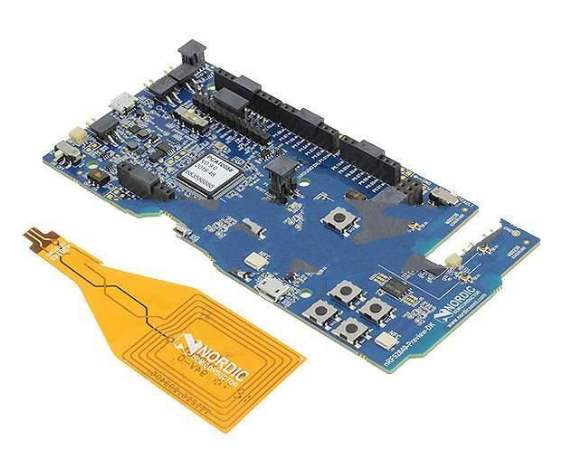
Nordic can help customers create overall solutions for wearable products by deploying the short-range low-power Bluetooth SoC nRF52840 and cellular network product nRF9160.
The nRF52840 is a multi-protocol Bluetooth 5.2 SoC supporting Bluetooth Low Energy, Bluetooth Mesh, NFC, Thread and Zigbee, with full multi-protocol concurrency and low energy consumption using a sophisticated on-chip adaptive power management system.
The nRF52840 is built around a 32-bit ARM® Cortex™-M4 CPU with a floating point unit running at 64 MHz. It features NFC-A tags for simplified pairing and payment solutions. The ARM TrustZone CryptoCell cryptographic unit is included on-chip and brings a wide range of cryptographic options that can be efficiently executed independently of the CPU. It features numerous digital peripherals and interfaces, such as high-speed SPI and QSPI for connecting external flash memory and displays, PDM and I2S for digital microphones and audio, and full-speed USB devices for data transfer and battery charging power.
in conclusion:
In short, wearable smartwatches are powerful tools for effectively monitoring our physical health through various sensors. Additionally, smartwatch technology will continue to evolve as sensors, semiconductors, and other components advance. By effectively combining these different smartwatch sensors and components, we can open up a world of possibilities with smartwatch devices.