IC 7490 Decade Counter: Pin Diagram, Working & Features
The IC 7490, also known as the Decade Counter, is a widely used digital component that plays a crucial role in various counting applications. Its ability to count from 0 to 9 makes it a fundamental building block in digital electronics, particularly in timing and frequency division circuits. In this blog, we will delve into the workings, pin configuration, and features of the IC 7490, as well as explore its applications and compare it to similar ICs like the IC 7493.
What Does IC 7490 Represent?
The IC 7490 is a decade counter, meaning it counts in decimal (base-10) from 0 to 9. This counting capability is achieved through a series of flip-flops, which divide the input frequency by 10. The IC 7490 is designed for use in digital circuits where a count of 10 is needed. It is often used in clocks, frequency counters, and timers, among other applications. Its versatility stems from its ability to operate in both asynchronous and synchronous modes, offering flexibility in circuit design.
What Is the Theory of Decade Counter IC 7490?
The theory behind the IC 7490 revolves around its ability to count in base-10. It consists of a series of flip-flops that change state in response to clock pulses. Specifically, the IC 7490 includes four flip-flops configured to count from 0 to 9. Each flip-flop represents a binary digit, and the combination of these flip-flops creates a binary sequence that corresponds to the decimal numbers 0 through 9.
When a clock pulse is applied, the first flip-flop toggles its state. After every tenth pulse, the count resets to zero, completing the decade cycle. This reset mechanism is what gives the IC 7490 its counting capability, making it a staple in digital counters.
7490 IC Decade Counter Pin Diagram
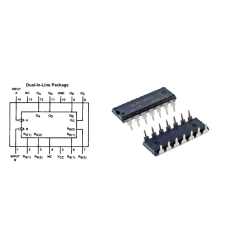
Understanding the pin configuration of the IC 7490 is crucial for integrating it into a circuit. The IC 7490 has 14 pins, each serving a specific function:
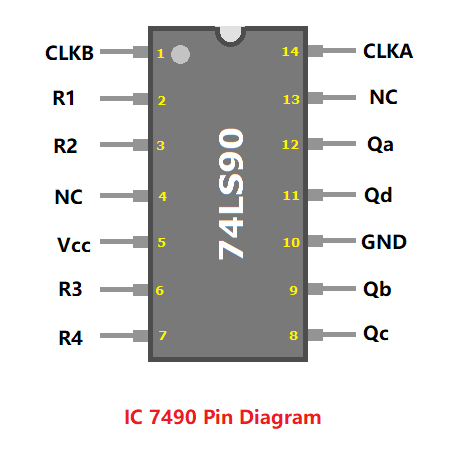
Pin No. 1: Clock Input B- There are two clock input pins in IC 7490. It is one of them.
Pin No. 2: R1 - It is the reset pin to reset the circuit to start the counting again.
Pin No. 3: R2 - It is also the reset pin.
Pin No. 4: NC - It is not connected to the circuit.
Pin No. 5: Vcc - It is the positive power supply pin.
Pin No. 6: R3 - It is the Reset Pin.
Pin No. 7: R4 - It is also Reset Pin.
Pin No. 8: Qc - Output Pin 3
Pin No. 9: Qb - Output Pin 2
Pin No. 10: GND - It is the Negative power supply Pin.
Pin No. 11: Qd - Output Pin 4
Pin No. 12: Qa - Output Pin 1
Pin No. 13: NC - Not connected to the Circuit.
Pin No. 14: Clock input pin A
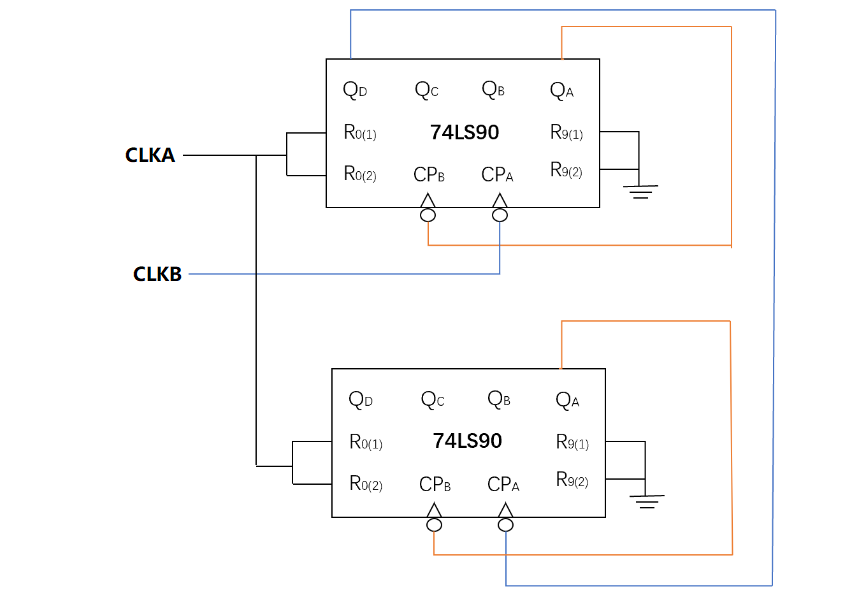
IC 7490 Circuit Diagram
IC 7490 Specification
Supply Voltage (Vcc): 4.75V to 5.25V
Operating Temperature Range: 0°C to 70°C
Propagation Delay (tpd): Clock to output: 22ns (typical)
Maximum Clock Frequency: 42 MHz
Output Current (IOH/IOL): IOL: 16mA (typical), IOH: -0.4mA
Power Dissipation: 500 mW (maximum)
High-Level Input Voltage (VIH): 2V (minimum)
Low-Level Input Voltage (VIL): 0.8V (maximum)
High-Level Output Voltage (VOH): 2.7V (minimum)
Low-Level Output Voltage (VOL): 0.4V (maximum)
Quiescent Supply Current (ICC): 22mA (maximum)
Input Clamp Voltage: -1.5V (maximum)
Noise Margin High: 0.8V (minimum), Low: 0.4V (minimum)
Package Type: 14-pin DIP
Asynchronous Reset: Available
Synchronous Operation: Supported
Thermal Resistance (θJA): 80°C/W for DIP package
Features of IC 74LS90
Low Power Consumption
The IC 74LS90 belongs to the LS (Low Power Schottky) series, which is known for its lower power consumption compared to the standard 7400 series. This makes it ideal for applications where power efficiency is critical, such as battery-operated devices.
Decade Counter
The IC 7490 is designed to count in decimal sequence from 0 to 9. It includes four internal flip-flops that allow it to perform decade counting, making it ideal for various counting applications where decimal counting is required.
Two Counting Modes
The IC 7490 supports two distinct counting modes. In the divide-by-two mode, the counter toggles between two states, effectively halving the input frequency. Alternatively, it can function as a three-stage binary counter, counting through eight binary states (000 to 111). In this mode, the counter performs a divide-by-five cycle, which is beneficial for applications needing more complex counting sequences.
Gated Zero Reset
The IC 7490 features a gated zero reset input. When this input is activated, the counter resets to zero, allowing the counting process to start from the beginning. This function is particularly useful in applications where a specific starting point is needed for accurate counting.
Gated Set-to-Nine Inputs
This feature enables the counter to be preset to nine (binary 1001) under certain conditions. It is especially useful for Binary-Coded Decimal (BCD) applications, where it is necessary to set the counter to nine for BCD arithmetic operations.
High-Speed Operation
The IC 74LS90 offers higher switching speeds than many other logic families, with a typical maximum clock frequency of 42 MHz. This high-speed capability is particularly useful in timing and frequency division circuits that require quick response times.
TTL-Compatible Inputs and Outputs
The IC 74LS90 is TTL (Transistor-Transistor Logic) compatible, meaning it can easily interface with other TTL logic devices. This compatibility ensures seamless integration into existing digital systems, reducing the need for additional interfacing components.
Quad Flip-Flop Structure
The IC 74LS90 consists of four flip-flops configured as a decade counter. Each flip-flop represents a binary digit, and together, they count from 0 to 9. This structure is fundamental to its operation as a decade counter, providing reliable and accurate counting in digital circuits.
Positive Edge Triggering
The IC 74LS90 is triggered on the positive edge of the clock signal, which helps in precise timing applications. This feature ensures that the counter updates its state only when the clock signal transitions from low to high, providing accurate counting.
Multiple Reset and Set Inputs
The IC 74LS90 includes separate reset and set inputs for its flip-flops, allowing more control over the initial state of the counter. This feature can be particularly useful in applications where the counter needs to start from a specific value or be reset under certain conditions.
Low Propagation Delay
With a low propagation delay, the IC 74LS90 ensures that the output changes quickly in response to changes in the input. This characteristic is essential in high-speed circuits where timing accuracy is critical.
Noise Immunity
The IC 74LS90 is designed with noise immunity in mind, ensuring stable operation even in environments with electrical noise. This is especially important in industrial and automotive applications where the IC might be exposed to electromagnetic interference.
What Does 7490 IC Do?
The 7490 IC functions as a decade counter, meaning it counts from 0 to 9 before resetting to zero. It is used in applications where a count of 10 is needed, such as in digital clocks, frequency counters, and timers. Here is the main function introduction of IC 7490.
1. Counting function
Pins A, B, C, and D can set the initial count value, which can be counted from 0 to 9 by entering different binary numbers. For example, if 0000 is entered, the output is 0001. When 0001 is entered, the output is 0010, and so on. When the counter counts to 9, the next count will return to 0.
2. Reset function
The R1, R2, R3, and R4 pins are used to reset the counter, which is reset to 0 when these pins receive a low level signal. This feature can be used when the count needs to be restarted, increasing the flexibility of the counter.
3. Clock input
The CLK pin is used to receive the clock signal. By controlling the frequency and pulse width of the clock signal, different working modes of the counter can be realized. For example, fast counting can be achieved by inputting a high-frequency clock signal, or frequency division can be achieved by inputting a timing pulse signal.
IC 7490 Truth Table
The truth table for the IC 7490 outlines how the output changes with each clock pulse. The table below summarizes the output states for each clock pulse. This truth table illustrates how the IC 7490 counts from 0 to 9 before resetting.
|
Clock Pulse |
QA |
QB |
QC |
QD |
|
0 |
0 |
0 |
0 |
0 |
|
1 |
1 |
0 |
0 |
0 |
|
2 |
0 |
1 |
0 |
0 |
|
3 |
1 |
1 |
0 |
0 |
|
4 |
0 |
0 |
1 |
0 |
|
5 |
1 |
0 |
1 |
0 |
|
6 |
0 |
1 |
1 |
0 |
|
7 |
1 |
1 |
1 |
0 |
|
8 |
0 |
0 |
0 |
1 |
|
9 |
1 |
0 |
0 |
1 |
|
Reset |
0 |
0 |
0 |
0 |
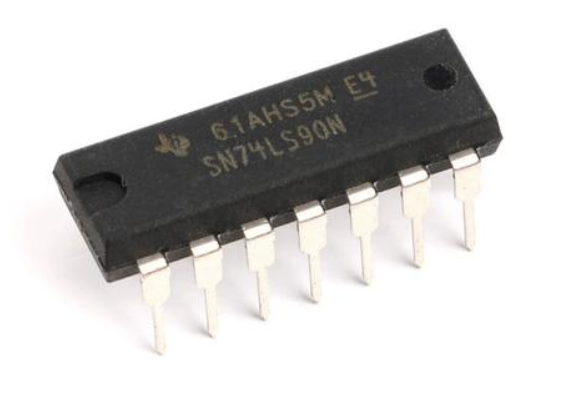
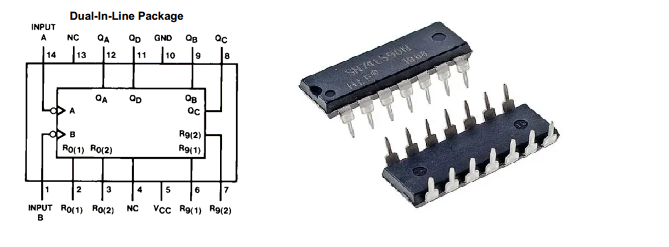
7490 IC Package
Is IC 7490 Asynchronous or Synchronous?
The IC 7490 is capable of both asynchronous and synchronous operation. In asynchronous mode, the flip-flops within the IC change state independently of the clock signal, based on the output of the previous flip-flop. In synchronous mode, all flip-flops are triggered simultaneously by the clock signal, providing a more coordinated counting process. This dual capability makes the IC 7490 a flexible tool in digital design.
Decade Counter IC 7490 Renowned Manufacturer
The IC 7490 is manufactured by several companies, including Texas Instruments, Fairchild Semiconductor, and NXP Semiconductors. These manufacturers are known for producing high-quality, reliable ICs that meet industry standards. Here are some other well-known manufacturers of 7490 IC listing as below:
l Texas Instruments (TI)
l NXP Semiconductors
l ON Semiconductor
l STMicroelectronics
l Fairchild Semiconductor
l Maxim Integrated
l Microchip Technology
l Intersil
l Rochester Electronics
l Analog Devices
Application of IC 7490
The IC 7490 is used in various applications, including:
Digital Clocks
The IC 7490 is commonly used in digital clocks to provide accurate timekeeping. By counting in decimal format, it helps in displaying hours, minutes, and seconds in a readable format. Its decade counting capability ensures the correct transition between digits, crucial for maintaining accurate time.
Frequency Counters
In frequency counters, the IC 7490 can measure and display the frequency of incoming signals. It divides the input frequency by a specific factor, allowing the measurement of frequencies in a range suitable for various applications, such as communication systems and signal analysis.
Timers
The IC 7490 is used in timing circuits to generate precise time intervals. By configuring the counter to operate in different modes, it can create delays and time intervals for applications in industrial automation, electronic timers, and event sequencing.
Event Counters
It serves as an event counter in systems that need to count occurrences of specific events. Whether tracking the number of products on a production line or counting pulses in a data stream, the IC 7490 provides accurate counting functionality.
Frequency Dividers
The IC 7490 can be used as a frequency divider to reduce the frequency of an input signal. This is useful in communication systems where signal frequencies need to be scaled down for further processing or measurement.
Pulse Counters
It can count pulses in digital circuits, making it suitable for applications such as measuring the number of pulses in a pulse train or counting digital events in electronics and telecommunications.
Decimal Counters for BCD Systems
The IC 7490 is well-suited for Binary-Coded Decimal (BCD) systems, where it can count in decimal digits and convert binary inputs into decimal outputs. This application is useful in systems that interface with digital displays or perform BCD arithmetic operations.
What Is the Difference Between a 7490 and a 7493?
The main difference between the IC 7490 and IC 7493 lies in their counting capabilities. The IC 7490 is a decade counter, counting from 0 to 9, while the IC 7493 is a binary counter, counting from 0 to 15 (in binary). This difference in counting range makes the IC 7490 more suitable for decimal counting applications, while the IC 7493 is better suited for binary counting.
Additionally, IC 7490 offers two primary modes of operation: a divide-by-two mode and a decade counting mode. It can be set up to divide the input frequency by 2 or count in a decimal sequence. However, the IC 7493 provides more flexibility with its counting modes. It can operate as a divide-by-2, divide-by-4, divide-by-8, or divide-by-16 counter, depending on the configuration of its control pins. It can also be configured for BCD (Binary-Coded Decimal) counting or as a modulo-N counter for various counting applications.
FAQs
Q1: Can the IC 7490 be used for higher counts?
A1: Yes, multiple IC 7490s can be cascaded to count beyond 9, allowing for higher counts in digital circuits.
Q2: What is the maximum operating frequency of the IC 7490?
A2: The IC 7490 can operate at a maximum frequency of 42MHz, making it suitable for high-speed counting applications.
Q3: Is the IC 7490 TTL-compatible?
A3: Yes, the IC 7490 is TTL-compatible, meaning it can be easily integrated with other TTL devices in a circuit.
Q4: How does the reset function work in the IC 7490?
A4: The reset function in the IC 7490 clears the counter, setting all output pins to zero, ready to start a new count.
Q5: Can the IC 7490 be used in synchronous mode only?
A5: Yes, the IC 7490 can be configured to operate in synchronous mode, where all flip-flops are triggered simultaneously by the clock signal.
Statement
All articles (images, texts, audio) on this site are uploaded and shared by users, or integrated from relevant internet sources, only for user's learning. If your rights are violated, please contact the administrator to delete! Link to this article: https://www.jinftry.com